Dorado Fish: The Complete Mahi-Mahi Guide
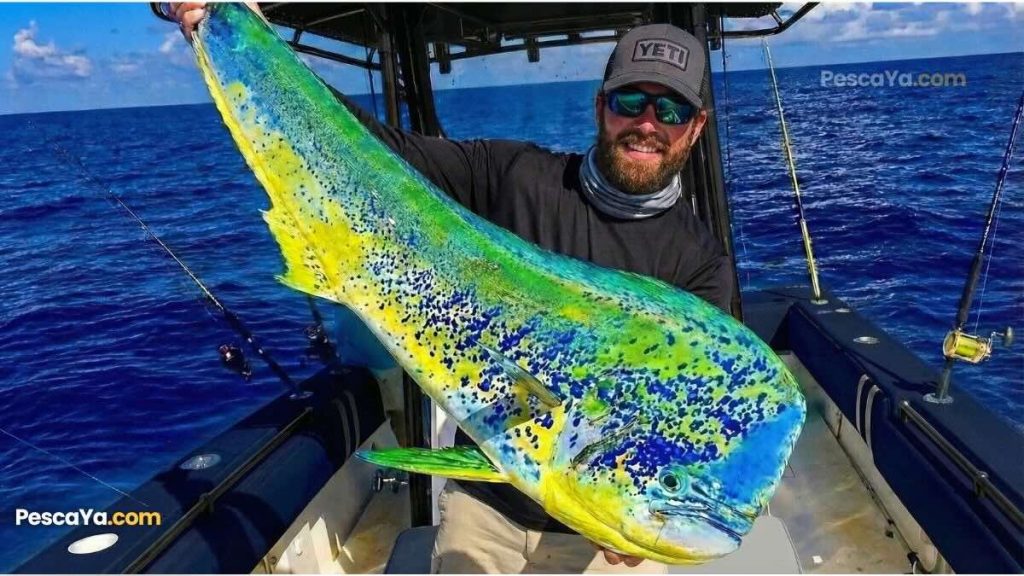
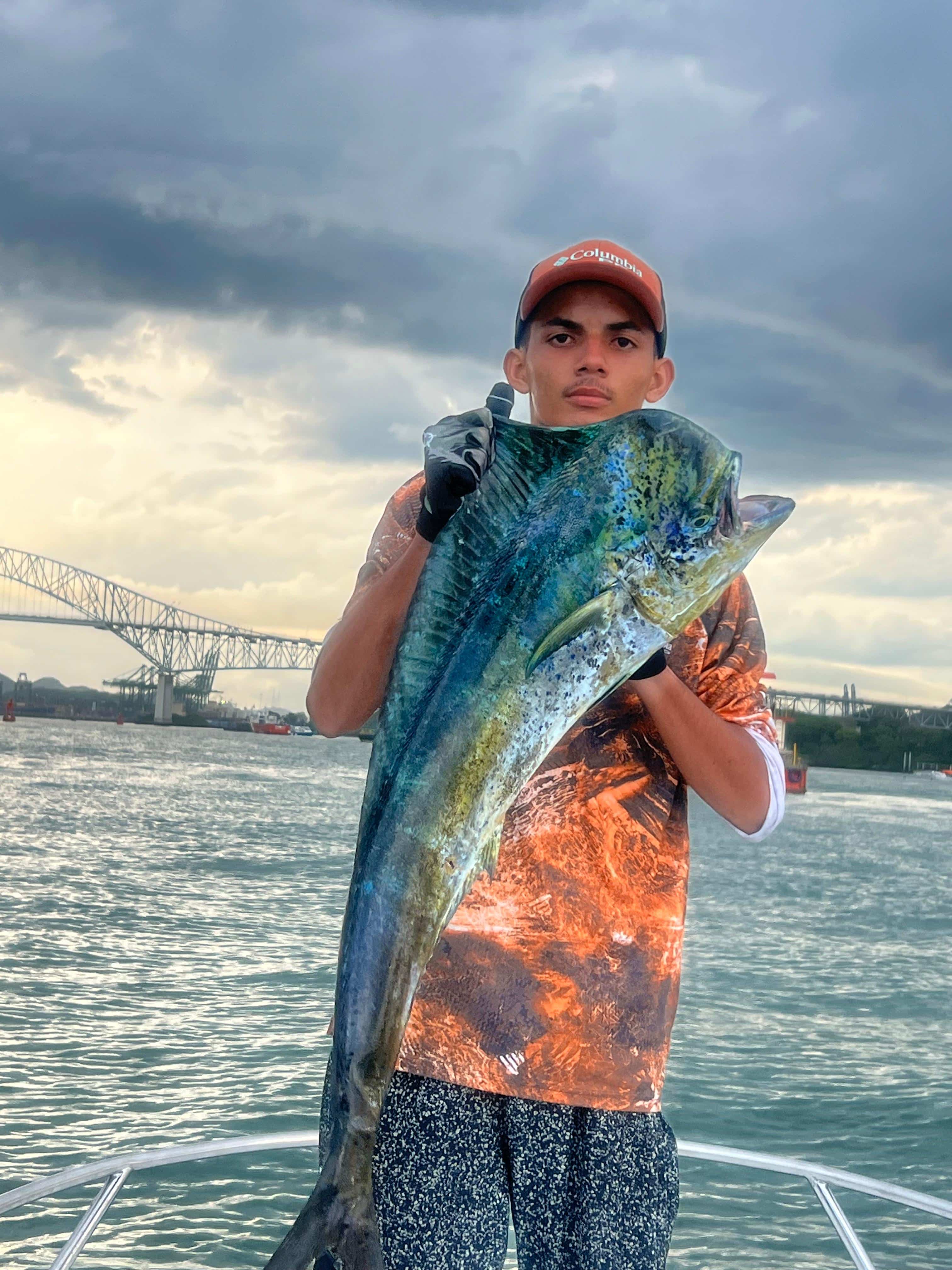
“Dorado” is Spanish for golden. Yet the living fish is a blazing electric blue and green — one of the most spectacularly colorful creatures in the ocean. It only turns gold when it dies.
Sailors named one of the sea’s most magnificent fish after the color it takes on in its final moments. That contradiction — luminous in life, golden in death — tells you everything you need to know about what makes the dorado so unforgettable.
Anglers know it by three names: dorado in Latin America and Spain, mahi-mahi in Hawaii and much of the Pacific, and dolphinfish in the English-speaking Atlantic world. All three names are a little confusing, and we’ll get to that. But whatever you call it — Coryphaena hippurus to scientists — this is one of the most sought-after offshore sport fish on the planet. Fast, acrobatic, beautiful, and genuinely delicious, the dorado delivers on everything an angler could want.
Here’s everything you need to know.
What Is a Dorado Fish?
Three Names, One Fish
The naming story is worth knowing because it comes up constantly on the water.
Dorado comes from the Spanish for “golden” — a reference to the yellowish-gold color the fish takes on after it dies, not the color it has in life. Spanish-speaking anglers throughout Central and South America have used this name for centuries, and it’s the dominant term in Mexico, Panama, Costa Rica, Ecuador, and beyond.
Mahi-mahi is Hawaiian. In the Hawaiian language, mahi means “strong,” but the Hawaiian linguistic practice of reduplication — repeating a word to amplify its meaning — makes mahi-mahi mean something closer to “extremely strong” or “very, very strong.” The people who named it were making a deliberate point about what happens when you hook one.
Dolphinfish came from early Atlantic sailors who watched the fish leap and porpoise alongside their ships. They looked like dolphins. The name stuck, which has generated centuries of confusion — dorado are not related to dolphins in any way. They don’t swim together. Anglers still field awkward questions about this to this day.
How to Identify a Dorado
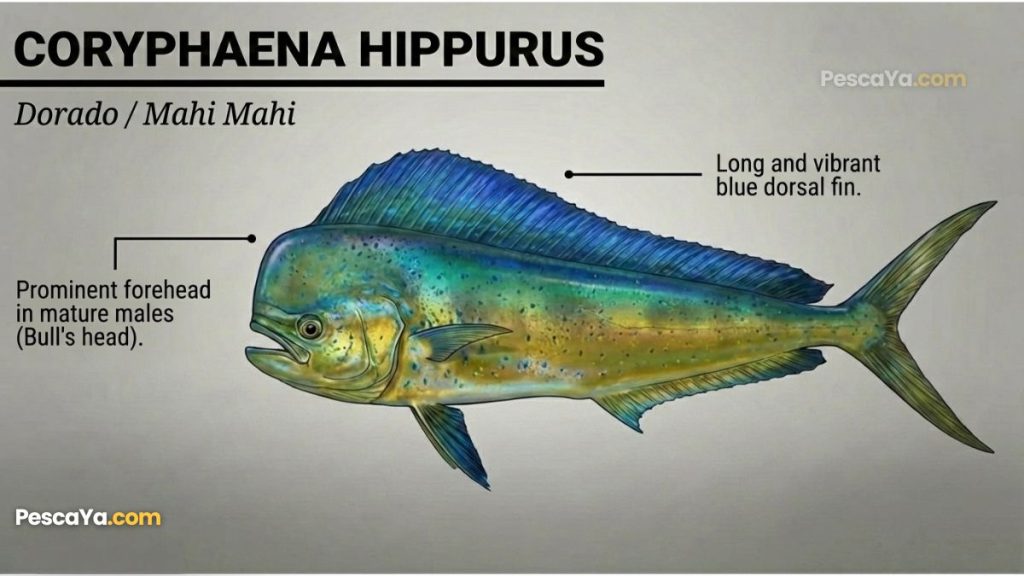
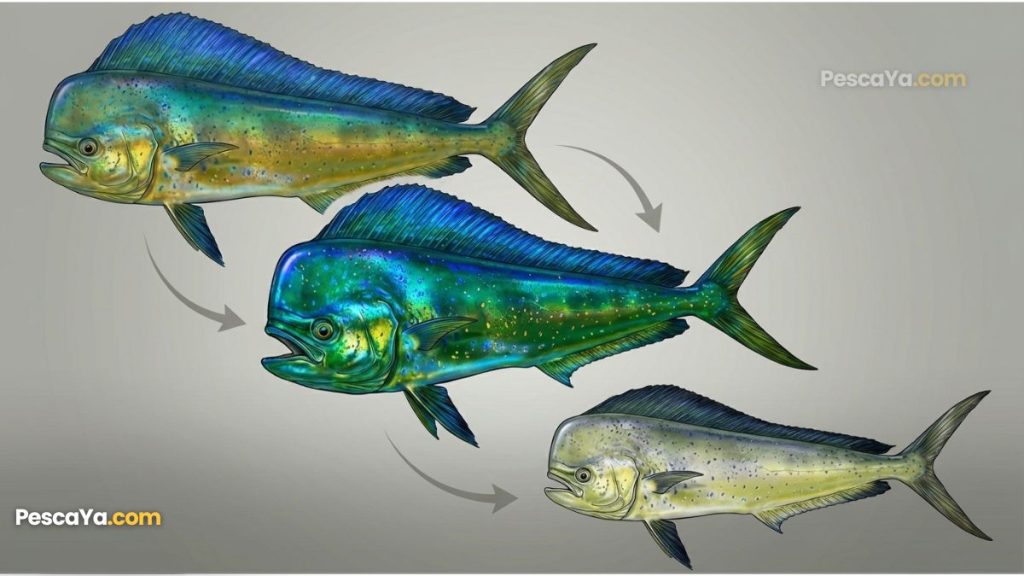
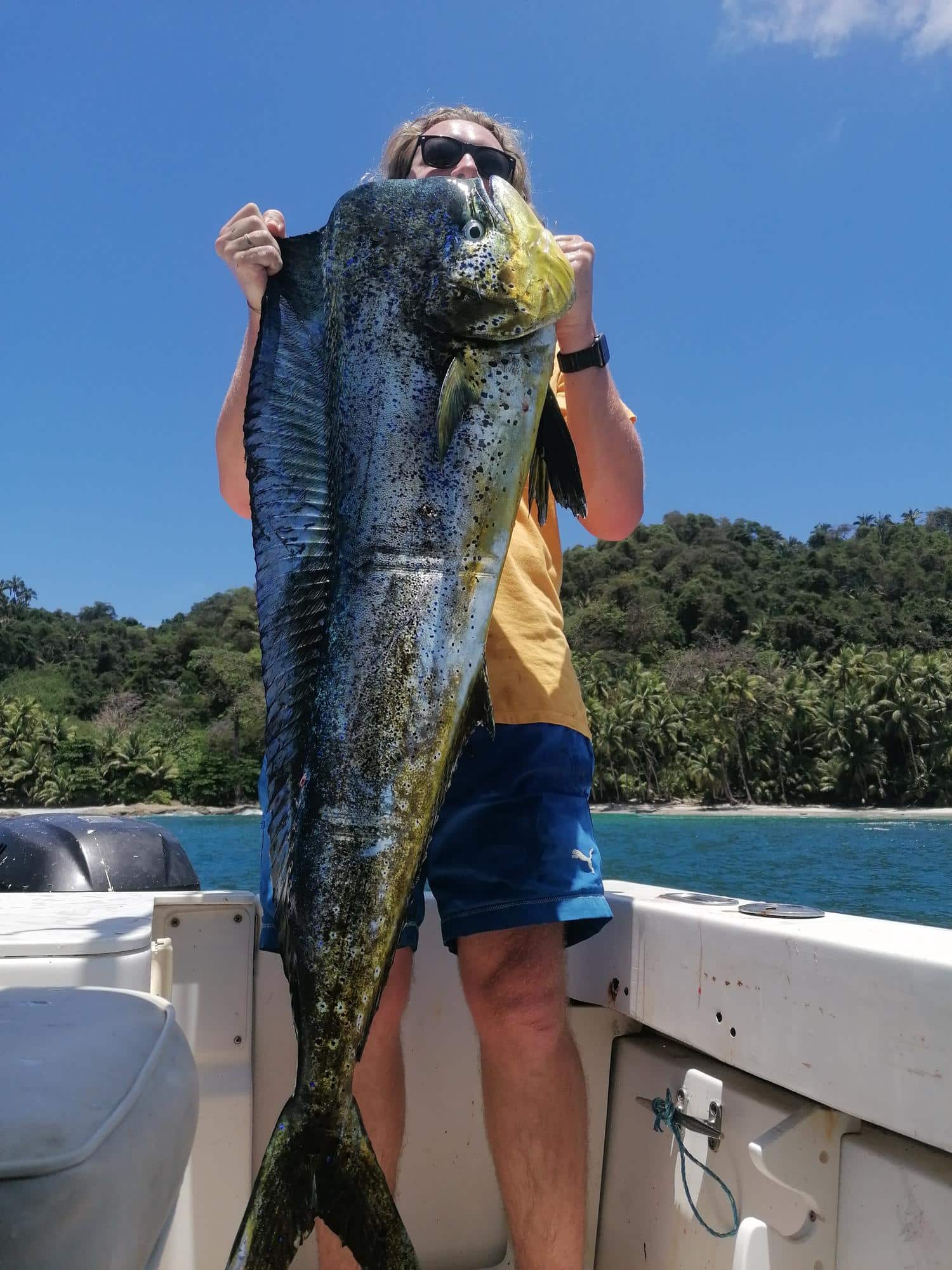
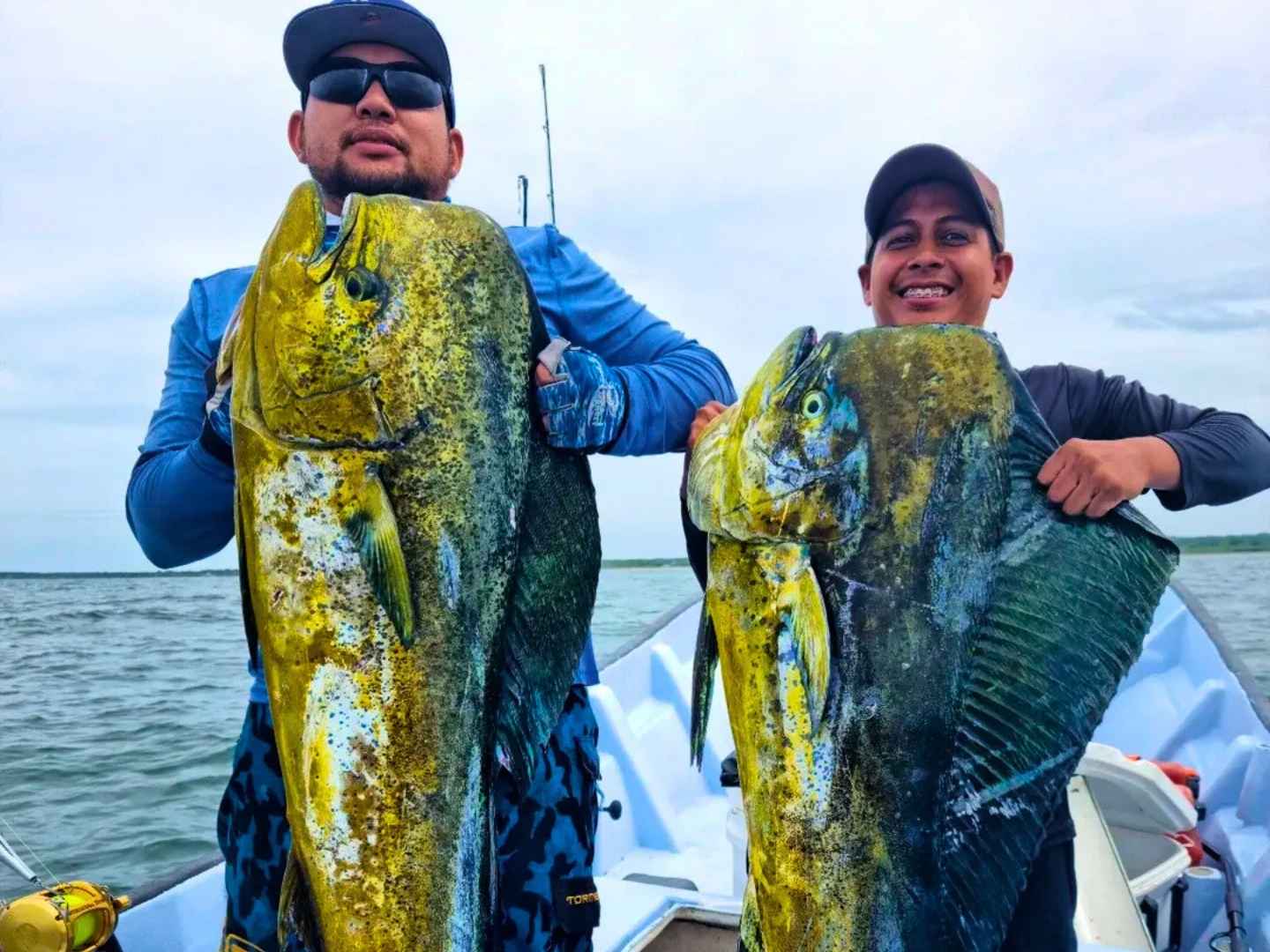
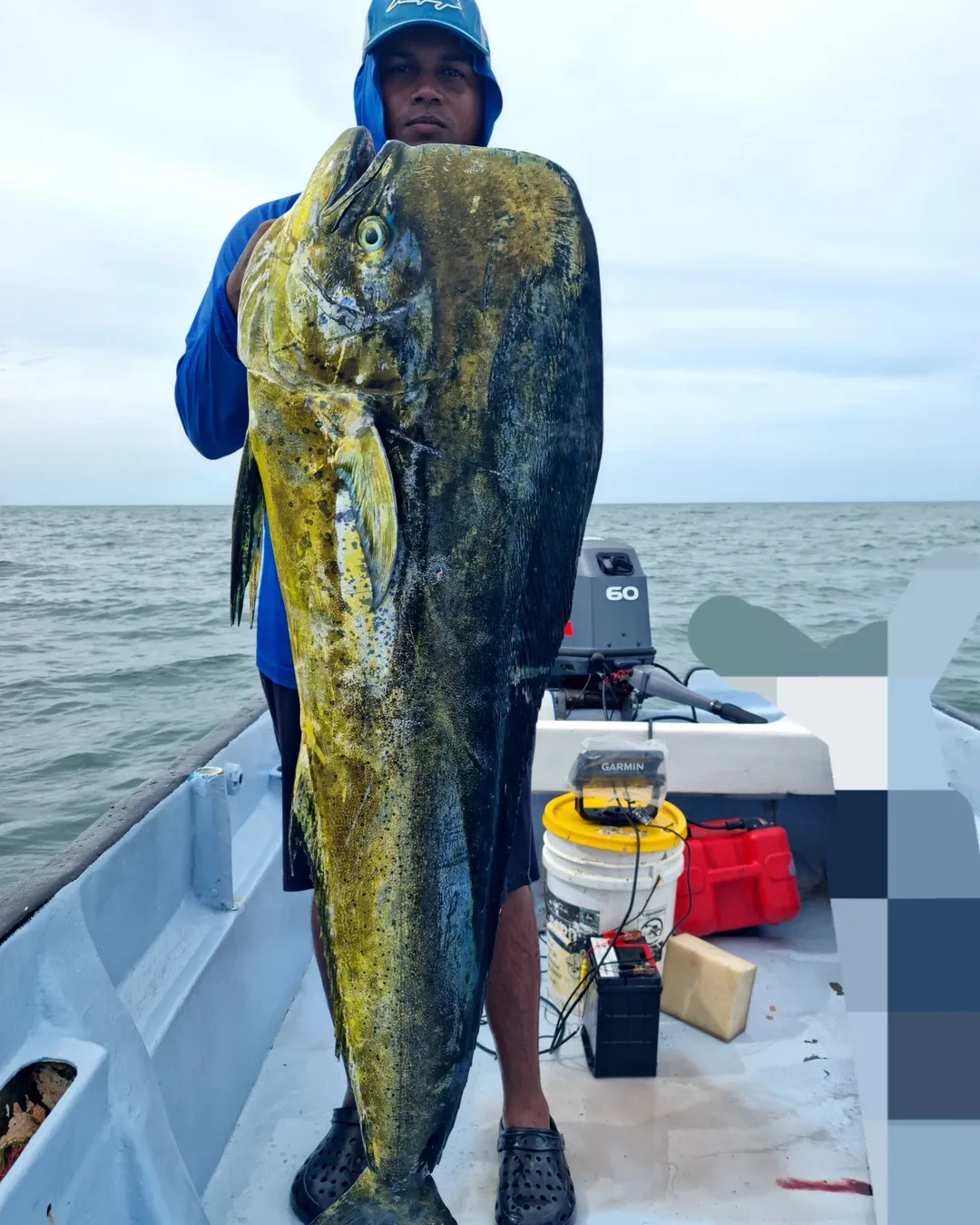
Dorado are unmistakable in the water. The back is an electric greenish-blue, the sides are golden and flecked with blue and black spots, and the belly shades to silvery-white or pale yellow. The pectoral fins glow with an iridescent blue. When the fish is excited — charging a lure, or freshly hooked — the colors intensify into something almost supernatural.
The easiest way to tell a male from a female is the forehead. Adult males, called bulls, develop a strikingly square and nearly vertical forehead as they mature. Females, called cows, have a smoothly rounded, tapered head. Bulls tend to run larger; cows tend to school more tightly.
Typical catches range from 15 to 40 pounds. Trophy fish push past 50. The IGFA all-tackle world record — 87 lbs 0 oz — has stood since 1976, caught in the Gulf of Papagayo, Costa Rica, by Manuel Salazar. That record has survived 50 years, dozens of failed challenges, and at least one unconfirmed catch out of Panama estimated at 115–120 lbs that was, unfortunately, never officially documented.
The Color Show — How Dorado Really Change Color
This is one of the most misunderstood things about dorado, and it’s worth getting right.
It’s Not Pigment — It’s the Scales
Most fish change color through chromatophores — specialized pigment cells that expand or contract to alter how much color shows through the skin. Dorado do have chromatophores, but that’s not where the show happens.
Dorado skin itself is a dull silver. The spectacular colors come from the scales, which are three-dimensional structures connected directly to the fish’s nervous system. When the fish gets excited, nerve signals cause the scales to physically rotate and tilt, catching light from different angles like small prisms. The result is that rippling, almost electric flash of blues, greens, and golds you see on a hooked fish — a display no paint or dye could replicate.
When a dorado dies, the nerve signals stop. The scales freeze in place. The light show ends, permanently and almost instantaneously.
The Death Sequence
Here’s the part most guides leave out. Right after a dorado dies, before the golden color appears, there’s a brief blue flash. Iridophore cells — a second type of structural color cell that reflects blue light passively, without needing a nerve signal — momentarily dominate as the nervous system shuts down.
For a few seconds, the fish glows with a cold, ghostly blue. Then those cells fade too, and the yellow-gold chromatophores — which don’t require active neural control to show their color — remain as the dominant tone. That’s the “dorado” the name references. The sailors who coined the term were watching a two-stage death sequence on their deck, and named the fish after the final phase of its light.
The Fastest Life in the Ocean
Dorado live faster than almost anything else swimming in open water. Understanding their biology is part of what makes them such an extraordinary fish to chase.
Growth That Defies Belief
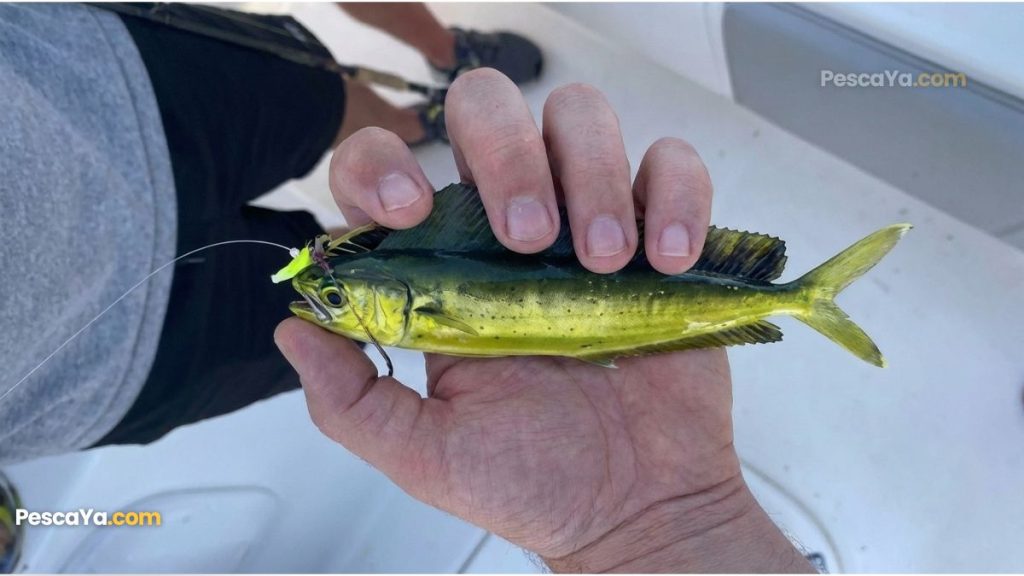
Juvenile dorado can grow up to 2.7 inches per week. In their first year, many reach over three feet in length. Tagging data from the Dolphinfish Research Program shows fish entering the recreational fishery — meaning large enough to catch on conventional tackle — as small as 6 inches fork length, though most catches occur above 14 inches.
Young dorado eat up to 19.8% of their body weight every day. To put that in human terms, it would be like a 175-pound person eating 35 pounds of food daily. They burn calories at an extraordinary rate to fuel that growth.
A 40-pound bull dorado you catch today is almost certainly less than two years old.
Reproduce Early, Reproduce Often
Dorado reach sexual maturity at just 4–5 months old. During spawning season, females release between 33,000 and 66,000 eggs — every 2–3 days. That’s not a typo. A single female spawns multiple times per week throughout the season, sometimes year-round in tropical waters.
This is why dorado populations recover so quickly from fishing pressure. Their minimum population doubling time is less than 15 months — faster than almost any other large pelagic species. It also makes them one of the most genuinely sustainable offshore targets you can chase, something NOAA rates as “Least Concern” on their stock assessments.
The Trade-Off
The price of living that fast is a short life. Most dorado don’t survive past 3–4 years. Some make it to five, and the genuinely exceptional ones reach six. The most spectacular sport fish in the offshore ocean is, biologically speaking, barely a teenager when most anglers encounter it.
Where in the World Do Dorado Live?
Dorado are a pelagic, surface-dwelling species found in tropical and warm-temperate oceans worldwide — the Pacific, Atlantic, Indian, and Caribbean all hold healthy populations.
What they follow isn’t a single factor but a combination: warm water temperatures (above 68°F), current edges and temperature breaks, lines of floating debris and sargassum, and baitfish schools — especially flyingfish, which make up roughly 25% of the dorado’s diet by weight. When you see birds diving near a floating kelp patty or a sargassum line, there’s a very good chance there’s a school of dorado underneath.
The Best Destinations for Dorado Fishing
Panama — The World Record Fishery
No place on earth has produced more documented dorado records than Piñas Bay, Panama, home of the legendary Tropic Star Lodge. The bay and surrounding waters hold 43 IGFA world records by line class and tippet for dorado alone — including Gary Carter’s astonishing 58-lb fish on 2-lb line, a fish-to-line ratio approaching 30:1 that remains one of the most impressive feats in sport fishing.
Panama’s Pacific coast peaks for dorado from May through December, with the rainy season pushing warm water and baitfish along the coast. November and December are prime for trophy bulls as it transitions into the dry season and large schools position themselves offshore. The Gulf of Chiriqui and the nearby Hannibal Bank rank consistently among the top offshore spots. The Azuero Peninsula — including Cambutal and Pedasí — produces exceptional action during the rainy months.

26 ft Up To 6 People
Costa Rica — Home of the World Record
The IGFA all-tackle world record for dorado was caught in Costa Rica — 87 lbs, Manuel Salazar, September 25, 1976, Gulf of Papagayo on the Pacific coast. That record has stood for almost 50 years, which says everything about what these waters are capable of producing.
Costa Rica offers year-round dorado fishing on its Pacific coast, with October to January generally considered the peak season for biggest fish. The mahi-mahi peak starts in October and builds through December, coinciding with the tail end of the rainy season when baitfish concentrations are at their highest. Top spots include Quepos and the Los Sueños/Herradura area in the Central Pacific, the Papagayo Peninsula in the North Pacific, and the Golfo Dulce and Drake Bay in the South Pacific.

21 ft Up To 4 People
Mexico — Year-Round Pacific Action

37 ft Up To 8 People
Mexico’s Pacific coast is a world-class dorado destination, with the Sea of Cortéz and Cabo San Lucas leading the list. Cabo has long been one of the top spots in the world for big dorado, with peak season running April through October and summer months typically producing the largest concentrations. The Sea of Cortéz channels baitfish and warm currents in ways that stack dorado throughout the season.
Further north along the Pacific coast, spots like Puerto Vallarta, Mazatlán, and Manzanillo offer excellent dorado fishing through the warmer months.
Beyond Central America
Hawaii sees consistent dorado year-round, particularly in the Kona and Maui offshore fisheries. The Florida Keys are the primary East Coast US destination, with the spring mahi-mahi run from March through May bringing large numbers through on the Gulf Stream. The Bahamas and the broader Caribbean offer quality dorado year-round, particularly around deep water drop-offs where warm currents concentrate the baitfish.
How to Catch Dorado
Start on the Troll, Then Switch
Most successful dorado trips begin trolling. Run at 5–8 knots with skirted lures, rigged ballyhoo, or bonito strips, covering water and watching for birds, debris, and temperature breaks. Once you raise fish — even on a single strike — slow down and switch tactics.
Dorado are a school fish. When you find one, you’ve usually found dozens.
The School Trick (And the Window)
This is the most important tactical point in dorado fishing, and most guides bury it in a sidebar: keep the first fish hooked in the water.
When a dorado sees its schoolmate come up into the boat, the school panics and disperses — sometimes within seconds. But a fish fighting in the water keeps the school nearby. Have cut bait ready before you bring the fish in. Throw chunks in the water, present live baits or small lures to the circling school, and work it methodically. Experienced crews can work an entire school of 20, 30, even 50 fish this way. The moment the last fish in the water comes over the rail with nothing else active — cut bait, hooked fish, or active lure — the school is gone.
The window is short. Have your crew ready.
Reading Debris
Any floating object — a palm frond, a bucket lid, a patch of sargassum, a FAD — is worth investigating. Dorado use floating structure as a kind of mobile base camp, hunting the baitfish that shelter underneath. Birds circling or diving over floating debris almost always indicates fish below. Approach quietly, present poppers or lures right at the edge of the structure, and watch what comes up from underneath.
Gear Recommendations
- Rod: 20–50 lb class, medium-heavy action
- Line: 30–50 lb braid with 40–80 lb fluorocarbon leader
- Lures: Bright skirted lures (pink, green, blue), rigged ballyhoo, small poppers for visual casting
- Live bait: Sardines, small skip-jacks, or ballyhoo when working a school
Frequently Asked Questions
Yes — dorado, mahi-mahi, and dolphinfish are all the same species: Coryphaena hippurus. The name varies by region. “Dorado” dominates in Latin America; “mahi-mahi” is standard in the Pacific and most US restaurants; “dolphinfish” or “dolphin” is common in the US Southeast Atlantic states.
Extremely. Dorado flesh is firm, mild, and slightly sweet — one of the best-eating offshore fish you can catch. It lends itself well to grilling, hard searing, and ceviche. Anglers who’ve spent time in Panama and Costa Rica tend to rank it in their top three table fish without hesitation.
The IGFA all-tackle world record is 87 lbs 0 oz, caught by Manuel Salazar on September 25, 1976, in the Gulf of Papagayo, Costa Rica. It’s one of the longest-standing saltwater records in existence. There is an unconfirmed catch out of Tropic Star Lodge in Panama estimated at 115–120 lbs, but it was never officially documented.
It depends on where you’re fishing. Panama peaks May through December, with trophy fish in November–December. Costa Rica’s biggest fish come October through January. Mexico’s Pacific coast produces well April through October. In all three destinations, dorado can be caught year-round — the peak seasons just offer better numbers and bigger fish.
Yes, though you generally need to reach open water and deeper offshore zones — typically more than 10–15 miles from shore. Dorado follow pelagic currents, not structure, so proximity to shore matters less than finding the right water temperature and baitfish concentrations. Charter boats are the most reliable way to put yourself in the right position, especially in unfamiliar waters.
Last Cast
Dorado are named for their death, fight like their life depends on it, and burn through their brief existence faster than almost anything else in the ocean. They’re also one of the most genuinely sustainable offshore targets you can chase — and one of the most memorable to catch.
Whether you’re chasing trophy bulls in Panama’s Piñas Bay, working the legendary Papagayo waters that produced the world record, or hunting the sargassum lines off Cabo, mahi-mahi never disappoint. Explosive surface strikes, neon acrobatics, and a cooler full of the best fish tacos you’ll ever eat.
Ready to find your own dorado? Explore our mahi-mahi fishing tours in Panama, Costa Rica, and Mexico, or browse the full range of Panama fishing tours to plan your trip.
Featured Posts
Quiere seguir leyendo?
Wahoo Fish: The Complete Sport Angler’s Guide
The name “wahoo” didn’t come from a map, a language, or a scientist. It came from an angler. Specifically, from...
Read More
->
Rainbow Bass Fishing: Complete Guide to Catching Guapote
Most anglers have never heard of rainbow bass. They don’t appear on bucket lists, they’re rarely mentioned...
Read More
->
Bluefin Trevally Fishing: Complete Eastern Pacific Guide
The Eastern Pacific is one of the great bluefin trevally fisheries on the planet — and among the most underrated....
Read More
->